
“Adherence to men is often disloyalty to
principles.”
– John Taylor of Caroline






Tertium Quids is an independent, nonpartisan, issue-advocacy
organization that promotes legislative efforts to expand individual
opportunity and free markets, while reducing the size, role, and cost of
government in Virginia.
.
Through grassroots education and mobilization, as well as direct contact with local and state officeholders, Tertium Quids redefines the parameters of the public debate in favor of individual liberty, dynamic entrepreneurial capitalism, private property, the rule of law, and constitutionally-limited government.
.
Tertium Quids, Latin for "third way" or "third entity," is composed of activists across Virginia whose loyalty and commitment are to the founding principles of our republic, rather than to party politics.
the John Taylor Memorial Fund
For 20 years, John Taylor anchored the Liberty Movement in Virginia. He acted within a strict framework of principle and dedication when such words had long fallen out of fashion. John prescribed to the Enlightenment beliefs of our Founding Fathers, defending their benefaction against the disrespect and degradation hoist upon it by so many Americans today. He always knew that without men like Jefferson, Madison, Washington, and Mason these same detractors would be indefinitely under the thumb of yet another series of overseers. John lived his life fulfilling his passion for Liberty in the Commonwealth of Virginia, and the Virginia Institute aims to stoke this fire even further.
To this end, the Virginia Institute introduces the John Taylor Memorial Fund. The money raised will go to the program about which John was most passionate, namely the Tuesday Morning Group coalition. The TMG coalition is among an exceptionally short list of the longest-lived, broad-based, state level coalitions in the nation, and it is growing. Fifteen years after its inception, the coalition has earned a storied history of affecting positive change in the name of the free-enterprise system, private property, and the rule of law in Virginia. Frankly, however, considerable work still needs to be done.
Join us in fueling the flame of John's passion and love for Virginia, and the Tuesday Morning Group. To support the John Taylor Memorial Fund, please make your check payable to Virginia Institute for Public Policy and mail your donation to PO Box 1123, Abingdon, VA 24212 or use the donate button below.
Sincerely,
Lynn Taylor
Posted This Week on
Freedom & Prosperity Radio
Jason Riley, member of the Wall Street Journal editorial board and author of Please Stop Helping Us: How Liberals Make It Harder for Blacks to Succeed, talks to us about his recent snafu with Virginia Tech. There are two rules to the race debate in today’s America, and black parents should be more worried than anyone else. Rule 1: If anything goes wrong, white racism is to blame; and Rule 2: Free speech should only apply to those who believe and abide by Rule 1. This “no we can’t till whites let us” mentality has even been brought up by celebrities (and we all know how in touch they seem to be). One pop star recently rejected Hillary Clinton saying she feels like Clinton talks to blacks as if they are “pets or children,” which strangely sounds like a description of Johnson’s Great Society program. Mr. Riley further discusses the incredibly precarious position that America finds itself as we approach an election that will likely determine the future of Liberty in the United States. There’s a question that none of us are willing to ask, but all of us are thinking: If not here, where will freedom ring?
If you’re looking for Mr. Riley’s book, Please Stop Helping Us: How Liberals Make It Harder for Blacks to Succeed. Check it out here. http://www.barnesandnoble.com/w/please-stop-helping-us-jason-l-riley/1118232831
Jason Riley, Pt. 1 Jason Riley, Pt. 2
Delegate Rob Bell, of Virginia’s 58th District, speaks on the extraordinarily horrifying attempt by Gov. McAuliffe’s office to positively spin the blanket return of voting and jury rights to (at least) 40,000 violent criminals. Apparently, even those who have not fully paid their debts to society, who are still serving their sentences through probation can now vote and serve on juries. Even more spectacular, Delegate Bell reports that if they happen to be re-entered into attendance in Virginia’s penal system for some violation of probation, they (currently) retain their rights to vote and sit on a jury. Is anyone else picturing a jury of our “peers” having to be kept under armed guard by prison wards? Simply amazing!
John Daniel Davidson, senior correspondent for the Federalist, describes the surprising turn from the free-market in Austin, TX as they recently pushed ridesharing wonder-companies Uber and Lyft from the city’s marketplace. The progressive island floating in a conservative sea has again proven its resilience against Liberty as the city-bosses backed their chosen corporate taxi cartels limiting the ride options in one of the most exuberant festival and bar towns in the country. I suppose we just chalk it up to more progressive support of blatant corporatism or does the city-counsel just hate Capitalism so much that they actually prefer drunk driving? Mr. Davidson also details the major operating differences between taxi services and ridesharing and the core failures in the progressive and corporate arguments against the wonderfully innovative companies that will now be dropping riders off at the Travis county line.
Take a look at Mr. Davidson’s article here: http://thefederalist.com/2016/05/10/uber-lyft-were-driven-out-of-austin/
.
.
.

.
.
.
.
.
TAKE THE PLEDGE...
.
.
...GET YOUR BUMPER STICKER
.
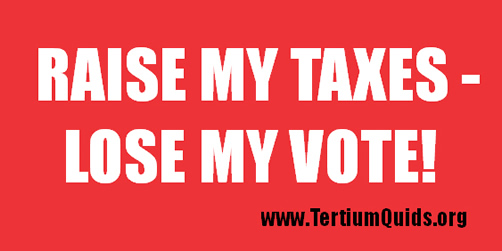
Tertium Quids announces a new grassroots campaign to return the citizens of Virginia to their rightful role as Sovereigns (remember We the People?), and to return our government to the Founders’ vision of a constitutionally-limited Republic.
In the past, there have been a number of attempts to gain a politician’s pledge not to raise taxes. These attempts have had limited success for one very important reason: politicians lie. Politicians are more than happy to take a pledge, or endorse your issue, without any expectation whatsoever of being bound by it.
Tertium Quids’ RAISE MY TAXES, LOSE MY VOTE campaign is different in that we are not asking politicians to do anything. Our pledge is for the people…
.
* people who understand that it is hard work, not entitlements, that brings success;
* people who understand that it is savings, not spending, that ensures prosperity;
* people who understand that it is the entrepreneur, not the bureaucrat, who creates jobs and economic growth;
* people who understand that it is morally reprehensible to enjoy current benefits while passing the costs of those benefits on to our children and grandchildren;
* people who understand that we can no longer tolerate intellectually bankrupt politicians whose one-step thinking process always leads them to the conclusion that more government spending and higher taxes are the only answers to every problem;
* people who understand that a nation’s wealth is built over many generations, but can be squandered in a decade.
If you are fed up, if you are willing to fight for future generations instead of plundering them, and if you are made of the same steel as your ancestors who fought for Virginia and the nation, then we invite you to sign the pledge that you will not vote for any politician who votes, or who promises to vote, to raise taxes. And to constantly remind politicians of your pledge and where you stand on taxes, we will send you a free RAISE MY TAXES, LOSE MY VOTE bumper sticker.
You cannot be economically enslaved and politically free.
.
Act now as if your liberty depended upon it!
.

.
.
.
.
.

.
A Citizens' Agenda for Better State Government
.
.
A coalition of Virginia citizen groups and legislators came together to introduce the Freedom & Prosperity Agenda — a citizens’ agenda for better state government that protects the time, labor, income, and property of all Virginians. These 11 planks were proposed as legislation in a multi-year effort to shift power from the government back to its rightful owners — the people. As you can see, some planks have already been passed, while others require increased grassroots support of people across Virginia — you, your family, and your friends and neighbors – to ensure our state legislators pass them into law.
.
1. Eliminate Virginia's death tax PASSED
.
2. Pass a Taxpayers Bill of Rights to limit excessive state spending
.
3. Stop unnecessary eminent domain confiscations of private property PASSED
STATUTE 2007
CONSTITUTIONAL AMENDMENT 2012
.
4. Allow parents to choose where their children attend school
.
5. Create freedom and fiscal accountability for Virginia’s public colleges and universities
.
6. Eliminate the prepayment of the sales and use tax
.
7. Eliminate the War of 1812 tax (BPOL tax)
.
8. Require expiration dates for all new taxes and all tax increases
PASSED THE HOUSE
.
9. Rein in skyrocketing real estate taxes by basing them on the acquisition value of property
.
10. Eliminate the car tax
.
11. Make more money available for transportation projects by protecting Transportation Trust Fund money from being used for non-transportation purposes PASSED THE HOUSE
.
.
Click here for more details on
the Freedom & Prosperity Agenda
Endorse the Agenda
Sign up for email updates
.
.
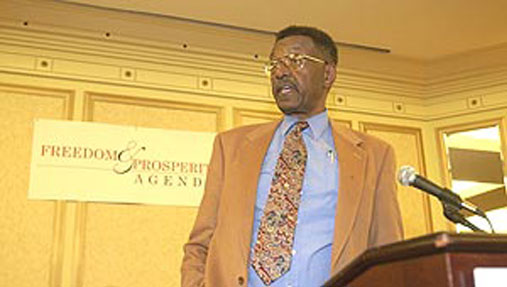
At a conference at the Omni Richmond Hotel,
Professor Walter Williams discusses the economic implications
of the Freedom & Prosperity Agenda and the need to
control the growth of government.
.
.

.
.


Tertium Quids
P.O. Box 1123 • Abingdon,
Virginia • 24212
(540) 245-1776